 Contents -
Previous Article -
Next Article
Contents -
Previous Article -
Next Article
A Picture Gallery of Fourth Century Reverse Types
The reverses of Fourth Century coins will usually have an allegorical figure symbolizing some virtue or value such as victory, a wreath, an altar, or an emperor in military dress dragging a captive or spearing a foe. Many variants of these basic reverse types exist. It is not rare for a collector to find that he or she has purchased an odd or rare variant of these types for only a few dollars out of an ancient coin dealer's junkbox. In fact, if you explore this site, you will see several pieces that are not found in any catalogue. This does not necessarily mean that the coin is a fake. There were so many different ways the ancient artist could have engraved a shield, armor, clothing, a figure of Victory, or the lettering in the inscriptions that thousands of interesting little varieties exist. Even the very thorough, painstaking research of the British Museum scholars and other numismatists working over the last one hundred fifty or more years has not brought all of them to the light of day. You may get lucky and find a real gem early in your collecting. The list below contains some of the more common varieties with which we'll start:
- Camp gate type with a representation of the gate of a walled Roman Fortress
- Votive altar with an inscription reading VOTIS XX or similar
- Two soldiers standing holding either one or two standards
- Wreath with an inscription inside reading VOT V MVLT X or some variation on this
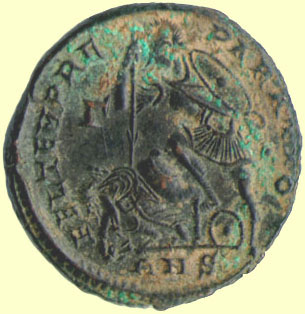
- Roman soldier spearing a fallen enemy horseman
- Wolf suckling the twins Romulus and Remus with VRBS ROMA inscription
- Victory standing on the prow of a Roman warship with CONSTANTINOPOLIS inscription
- Very tiny coin with two victories each holding a wreath
- Emperor Holding a military standard or a labarum or Christian battle standard
- Victory in long flowing dress advancing left holding a wreath
Return to Fourth Century Roman Bronze Table of Contents - This topic table of contents.
Return to Roman Coins Table of Contents - Up one level.
Return to History and Technology Back Pages - The home page for this entire site.
Please Click One of the Following Links to Choose Another Article in the Late Roman Bronze Series.
Identifying Common Fourth Century Roman Bronze Coins
Reading the Emperor's Name and Titles
A Picture Gallery of Fourth Century Reverse Types
Camp Gate
Altar Inscribed VOTIS XX
Two Soldiers Standing With Two Standards
Two Soldiers Holding One Standard
Wreath With Legend Inside
Soldier Spearing a Fallen Horseman
VRBS ROMA Commemorative - Mother Wolf Suckling Twins Romulus and Remus
CONSTANTINOPOLIS Commemorative - Victory Standing on Prow of Ship
Two Victories Each Holding a Small Wreath
Two Victories Each Holding a Large Wreath on Centenionals of Decentius
Emperor Holding Labarum or Standard and Dragging Captive
Emperor Raising Kneeling Captive
Victory Advancing Left
A Key to Fourth Century Inscriptions
Some Scarcer Late Fourth Century and early Fifth Century Types
All New! More image galleries of late Roman bronze types.
Camp Gate
Altar with Votis, Victories with Wreath
FEL TEMP REPARATIO, Soldier Spearing Fallen Horseman
More FEL TEMP, including Barbarian and Hut tupes
Victory Advancing Left Holding Wreath
Emperor Holding Labarum and Dragging Captive